Section 10. Science and innovations
10.3. International Research Institutes Working on Water Issues in Central Asia
TOO “Central Asian Regional Glaciological Centre (CARGC) under the auspices of UNESCO”
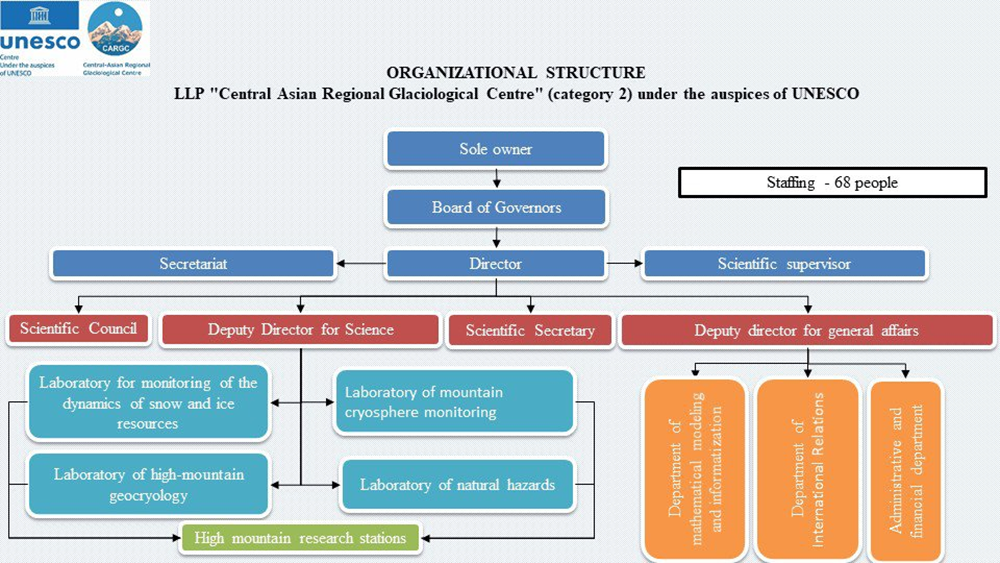
 The establishment of the Centre was initiated in 2006 on the basis on the Institute of Geography and Water Security of Kazakhstan. An agreement on its establishment was signed in 2012 and subsequently ratified in 2017 (ZRK No. 50-VI of 01 March 2017). The official registration of the institution in the format of the limited liability partnership - TOO “Central Asian Regional Glaciological Centre” (CARGC) as a category 2 under the auspices of UNESCO took place on 28 May 2020.
In 2025, the Centre’s mandate was extended: a Memorandum of Understanding between UNESCO and the Centre, as well as an Agreement between the Government of the Republic of Kazakhstan and UNESCO were signed for a period of eight years. The Agreement was concluded in Astana on 19 June 2025 and ratified by ZRK No. 250-VIII of 30 December 2025. According to Article 4 of this Agreement, the Centre shall be legally independent of UNESCO.
The main functions and objectives of the Centre include: coordinating research and exchanging data on the state of glaciers, snow cover, and permafrost in Central Asia; studying the impact of climate change on water resources; developing regional scientific programmes; facilitating training and raising awareness of climate risks; and, disseminating research results through educational and scientific events.
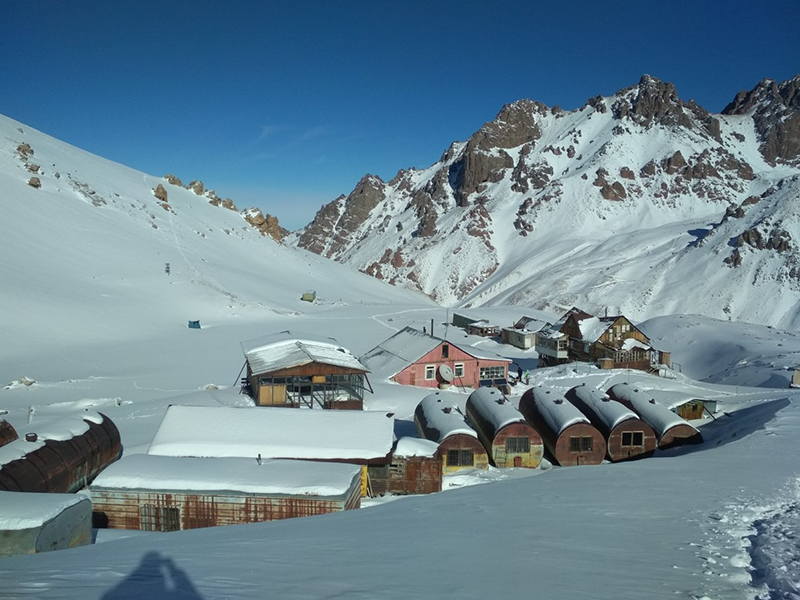
The Centre has three high-altitude stations in Ile Alatau mountains: (1) “Zhosaly Kezen Pass” geocryological station (at 3,300 m above sea level, 36 km from Almaty); (2) Tuyuksu Glacier glaciological station (at 3,400 m above sea level, in Kishi Almaty River basin, 20 km from Almaty); (3) «Big Almaty Lake» geoecological station (at 2,500 meters above sea level in the Ulken Almaty river basin, on the bank of Big Almaty Lake, 24 km from Almaty).
Activities in 2025
Research. The Centre’s high-mountain stations monitor the thermal regime of and study the impacts of climate change on permafrost, survey snow cover, avalanches, and other hazardous exogenous processes, and test methods for assessing recreational resources. Year-round observations of the glacier’s mass balance components are conducted at the Tuyuksu Glacier station.
The Centre is implementing the following projects: (1) «Strengthening the resilience of Central Asian countries by enabling regional cooperation to assess glacio-nival systems to develop integrated methods for sustainable development and adaptation to climate change» (GEF-UNDP-UNESCO, 2024-2025), under which the Centre’s specialists participated in workshops in Samarkand, Uzbekistan, on 2-3 April; in Almaty, Kazakhstan, on 15-16 April, and in Ashgabat, Turkmenistan, on 12-13 May; in cooperation with the scientists from the University of Fribourg, organized Summer school «Geophysical Methods for Studying Permafrost and Rock Glaciers» (Zhosaly-Kezen Pass, 23-27 June); (2) «Understanding hydrological processes in glacierized catchments under changing climate using isotope techniques» (IAEA, 2024-2028); (3) «Reducing vulnerabilities of populations in the Central Asia region from glacier lake outburst floods in a changing climate» (UNESCO-Adaptation Fund, 2025).
Capacity building. The Centre organized training on «Health and Safety in High-Altitude Environments» at the Tuyuksu Glacier Station (17-19 June) and «Safety Techniques for Glacier Fieldwork» (20-21 June).
Events. As part of the International Year of Glacier Preservation, CARGC held a round table dedicated to the World Glacier Day (20 March) and the ceremonial cancellation of the postage stamp (17 October).
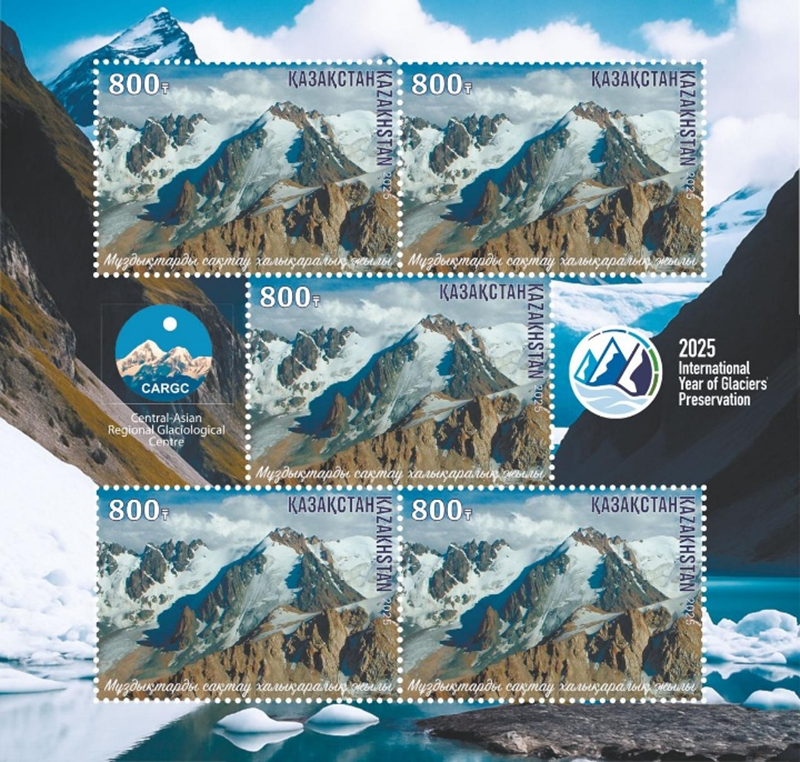
Representatives of the Centre specialists took part in the following events: (1) International High-Level Conference on Glaciers’ Preservation (Dushanbe, Tajikistan, 28 May-1 June); (2) International Photo Exhibition “Walk of Water: Stories of Ice, Rivers, and Drought” (Аlmaty, 4 June); (3) Third United Nations Ocean Conference/UNOC3 (Nice, France, 9-13 June); (4) celebration of the 50th anniversary of the Intergovernmental Hydrological Programme (IHP) and the 60th anniversary of UNESCO’s Division of Water Sciences (Paris, France, 10-13 June).
Development and support
Scientific-Information Center ICWC